Review eight numbers every week: renewal rate, day-90 retention, active members, monthly recurring revenue, members inactive for 10+ days, overdue renewals, lead conversion, and personal training sessions used. Monthly collections alone can look healthy while members are quietly leaving, because annual plans bring in cash long before a member decides not to come back.
Why collections mislead you
A burst of annual sales in January can hide a retention problem until the following January. Recurring revenue spreads those sales over the months they actually cover, so a ₹30,000 annual plan counts as ₹2,500 a month. That gives a truer picture of the business.
The weekly eight
| Number | How to work it out | If it worsens |
|---|---|---|
| Renewal rate | Plans renewed ÷ plans that ended | Call lapsed members and ask why |
| Day-90 retention | New joiners still active at day 90 ÷ all who joined that month | Review your induction |
| Active members | Members with a live plan | Compare joins with exits |
| MRR | Each live plan's price ÷ its months, added up | Check discounts and plan mix |
| Inactive 10+ days | Live members with no visit or workout in 10 days | Trainer follows up this week |
| Overdue renewals | Plans expired but not renewed, and their value | Reach out early, before they settle elsewhere |
| Lead conversion | Leads joined ÷ all leads, by source | Check follow-up speed by source |
| PT sessions used | Sessions used ÷ sessions sold | Low use today means no renewal later |
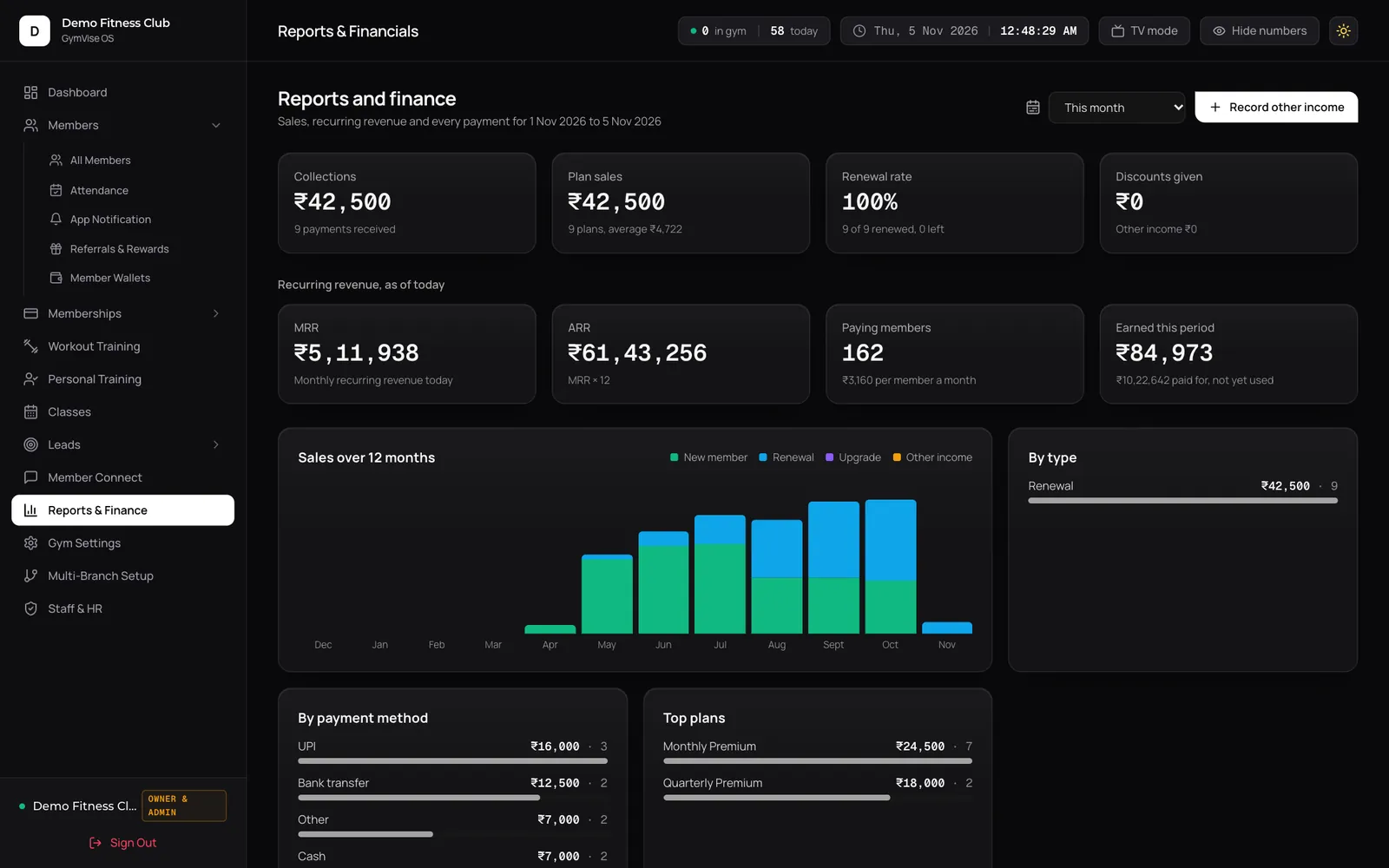
A worked example
These figures are made up to show the maths. Suppose a gym has 300 live members, with 180 on ₹3,500 monthly plans, 80 on ₹9,000 quarterly plans and 40 on ₹30,000 annual plans.
- Monthly plans: 180 × ₹3,500 = ₹6,30,000
- Quarterly plans: 80 × ₹3,000 = ₹2,40,000
- Annual plans: 40 × ₹2,500 = ₹1,00,000
- MRR: ₹9,70,000, or about ₹3,233 per member per month
Now the owner can ask useful questions. What happens if 20 monthly members move to annual plans? It brings in cash upfront, but MRR falls, because the annual price works out cheaper per month.
What attendance tells you
The TRP 10,000 research found that a member base attending three or more times a week generated 17% more total income over 24 months than one attending less than once a week. It is UK data, but the idea travels: attendance leads revenue. You will see it fall before you see the money fall.
A 15-minute Monday routine
- Look at the inactive list and hand names to trainers.
- Look at plans expiring in the next 14 days.
- Check last week's leads: does each one have a next follow-up date?
- Note one number that surprised you and find out why.
GymVise's owner dashboard shows these lists without exporting anything. If you are still on spreadsheets, start with how to move from Excel. You can model the revenue impact with the gym revenue and churn calculator.
Sources
Checked 5 November 2026. Figures from other countries or from vendors are labelled as such, and any example marked as illustrative is not a benchmark.
See how it would work in your gym
We can walk you through the member app and owner dashboard using your own plans.
Book a free demoFrequently asked questions
Monthly recurring revenue. Divide each live plan by the months it covers and add them up. A ₹9,000 quarterly plan counts as ₹3,000 a month.
There is no reliable public benchmark for Indian gyms, and it varies by format and plan length. Track your own trend by plan type and aim to improve it each quarter.
Attendance, overdue renewals and leads weekly, because you can still act on them. Profit and capacity decisions monthly.