A hybrid membership covers a member’s whole training week, not only the hours they spend in your building. They train with you three or four days, and follow your trainer’s plan in the app on travel days, home days and park runs. For an independent gym it is one of the clearest ways to look more modern than a chain without a bigger floor, because the extra value is coaching and programming, not square feet.
What does “hybrid” actually mean for a gym?
In most Indian gyms a membership buys access to the floor and, sometimes, a few group classes. A hybrid membership buys a training relationship: the gym writes the member’s week, and the member follows it wherever they are. The gym visit stays the centre of it. The app carries the plan between visits.
That matters because members do not stop training when they are away from you. They travel for work, visit family in another city, or work out at home when the Delhi winter smog keeps them indoors. If your gym is absent on those days, the habit you built starts to break, and so does the renewal.
Why is 2027 the year to offer one?
The fitness industry’s own trend surveys point the same way. The American College of Sports Medicine’s survey of more than 2,000 fitness professionals ranks wearable technology as the top trend for 2026, for the third year running, with mobile exercise apps also in the top five and data-driven technology in the top ten. It is a US-led survey, but your members use the same phones and watches.
The bigger reason is local. Chains in Delhi NCR sell access to many locations. You cannot match that with branches, but you can match it with reach: a member who has your plan on their phone is your member in a Goa hotel or a Noida apartment as well as on your floor.
Who is a hybrid membership for?
- Frequent travellers. Consultants, sales teams and founders in Gurugram and Noida who are on the road one week a month.
- Parents with tight mornings. Two coached sessions at the gym and two short home sessions are realistic. Five gym visits are not.
- Runners, cyclists and sport players. They train outdoors anyway, and want strength work that fits around it.
- Members coming back from a break. A plan that starts partly at home lowers the barrier to returning.
How should you structure it?
Keep it simple enough for the front desk to explain in one sentence. A workable design:
- A base of in-gym access. The same floor access as your standard plan.
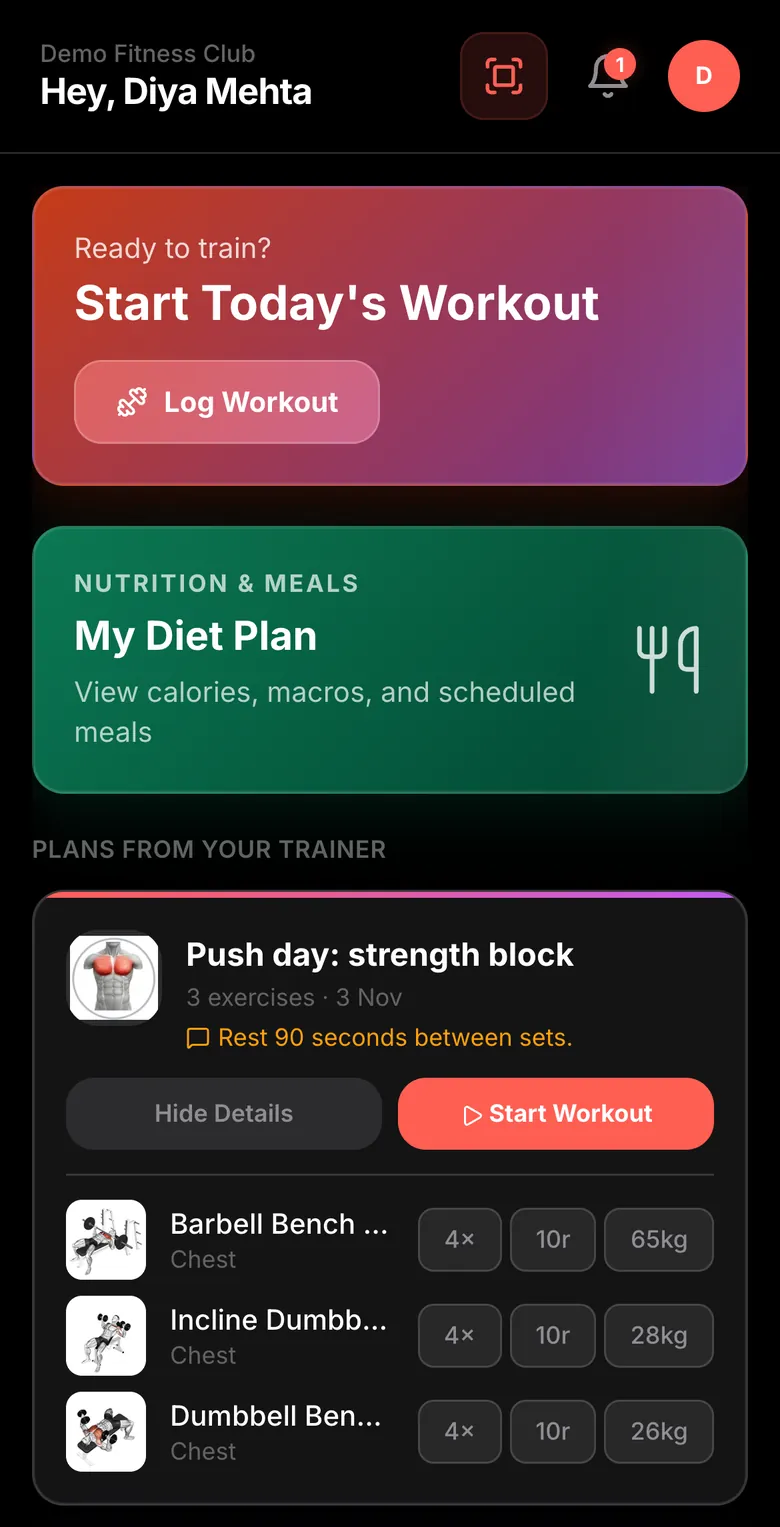
- A written weekly plan in the app. Gym days and non-gym days, built by a trainer from a template and adjusted monthly.
- A monthly check-in. Fifteen minutes with a trainer to review logged workouts, measurements and how the plan is going.
- Clear limits. Say what is not included, for example one-to-one sessions, so it never competes with your PT packages.
The plan does not need video production. A clear list of exercises, sets, reps and target weights, with last session’s numbers beside them, is what members use. Fancy content that nobody updates is worse than a plain plan that a trainer reviews.
How do you price it?
Price the hybrid plan above your standard membership and below your PT packages. The extra cost to you is trainer time for plan writing and the monthly check-in, so price that time honestly. As an illustration only: if a trainer spends about 30 minutes a month per hybrid member and you value trainer time at ₹600 an hour, the plan needs to earn at least ₹300 a month more than floor access before it adds margin.
Do not discount it to compete with a chain. The point of a hybrid plan is that the chain’s cheapest plan does not include a coach writing the member’s week. Read how to price against chains for the wider approach.
How do you know it is working?
Track three things monthly for hybrid members against your standard members:
- Workouts logged per week, both in the gym and away from it.
- Visits per week to the gym. A hybrid plan should not reduce visits. If it does, the in-gym days are not valued enough.
- Renewal rate at the end of the term. This is the number that justifies the plan.
Research on gym retention from the UK’s TRP 10,000 study found that members who visited at least once a month were 27% less likely to cancel in the next month during their first six months. Logged activity away from the gym is not the same as a visit, but it is the same signal of a habit that is alive.
Common mistakes
- Selling it as “online training”. Members already have free videos. Sell the trainer, not the content.
- No review loop. If nobody looks at what the member logged, the plan quietly dies.
- Too many tiers. One hybrid plan beside your standard and PT plans is enough to start.
What GymVise does and does not do here
GymVise lets trainers assign workout plans from templates, and members log every set in the app wherever they train, with their previous numbers beside each exercise. Trainers see the logged workouts and measurements for each client, and the owner dashboard shows attendance, so you can compare hybrid members with everyone else. GymVise does not sell video workout libraries or connect to wearables, so a gym that wants streamed classes needs a separate tool.
Sources
- ACSM: Top fitness trends for 2026 (survey of 2,000+ fitness professionals)
- Health Club Management: Retention, it all adds up (Dr Melvyn Hillsdon, TRP 10,000, 2015)
Checked 14 November 2026. Figures from other countries or from vendors are labelled as such, and any example marked as illustrative is not a benchmark.
See how it would work in your gym
We can walk you through the member app and owner dashboard using your own plans and timetable.
Book a free demoFrequently asked questions
A membership that covers in-gym training plus a trainer-written plan in an app for the days a member trains elsewhere, with a regular check-in to review progress.
It should not, if the in-gym days carry the heavy, coached sessions. Track visits per week for hybrid members and change the plan design if they fall.
More than floor access and less than personal training. Price the trainer time it uses, typically plan writing plus a short monthly check-in, rather than matching a chain’s discount.